


Pricing is the question every Etsy seller gets wrong at least once — and for many sellers, it is the reason their shop never becomes profitable no matter how many sales they make. They price too low to compete, or they guess based on what competitors charge, or they forget to account for Etsy’s fees entirely. Then they wonder why 50 sales a month still feels like they are barely breaking even.
This guide covers exactly how to price your Etsy products in 2026 — with the actual updated fee numbers, a clear pricing formula, and answers to the most common pricing questions sellers ask on Reddit and Etsy forums every single day.

Why Most Etsy Sellers Price Wrong
Before getting into the formula, let’s look at the three most common pricing mistakes — because understanding the mistake is the fastest way to stop making it.
Mistake 1: Pricing based on what competitors charge without knowing their costs. Just because a competitor is selling a similar product for $15 does not mean $15 is profitable. They might be losing money. They might have lower material costs. They might be a large operation with volume discounts. Copying competitor prices without knowing your own costs is a recipe for running a hobby, not a business.
Mistake 2: Forgetting to include Etsy fees in the price. Etsy’s fees are not small. Between transaction fees, payment processing, listing fees, and potential offsite ads fees, Etsy can take 15–20% of your revenue on a single sale. Sellers who don’t build this into their price are essentially giving away 15–20% of every sale.
Mistake 3: Underpricing to compete with mass-produced items. Handmade, custom, and unique products are not competing with Amazon or Alibaba. Buyers on Etsy are specifically looking for something different from what they can get mass-produced — and they are willing to pay for it. Underpricing your handmade items trains buyers to undervalue them.

💡 TIP: Your price needs to cover your costs, pay you fairly for your time, and leave room for profit after fees. If your current pricing does not do all three of those things simultaneously, it needs to change.
Every Etsy Fee You Need to Know in 2026
Before you can price correctly, you need to know exactly what Etsy takes from each sale. These are the current 2026 Etsy fees:
Listing Fee — $0.20 per listing, charged every time you publish or renew a listing. Listings auto-renew every 4 months.
Transaction Fee — 6.5% of the total sale price including the shipping amount you charge the buyer. This is the biggest fee and the one most sellers forget to include in their calculations.
Payment Processing Fee — 3% of the total order value plus $0.25 per transaction. This applies when buyers pay through Etsy Payments, which is the standard payment system in most countries.
Offsite Ads Fee — 12% to 15% of the sale price when a buyer finds your listing through Etsy’s offsite advertising on Google, Facebook, Pinterest, or other platforms and purchases within 30 days. If your shop has made less than $10,000 USD in the past 12 months, you can opt out of Offsite Ads. If you have made more than $10,000, participation is mandatory.
Etsy Ads Fee — Optional. If you run Etsy Ads, you pay your chosen daily budget amount regardless of whether those clicks convert to sales.

Let’s see what this looks like on a real sale. Say you sell a product for $25 with $5 shipping — total order value $30:
Listing fee: $0.20
Transaction fee (6.5% of $30): $1.95
Payment processing (3% of $30 + $0.25): $1.15
Total mandatory fees: $3.30
That is $3.30 Etsy takes from a $30 sale before you have paid for materials, packaging, your time, or shipping. If you also had an Offsite Ads sale at 15%, add another $4.50 to that number — making total fees $7.80 on a $30 sale.
💡 TIP: Always calculate your fees on the total order value — not just the item price. Because Etsy’s transaction fee applies to both the item price and the shipping charge, free shipping does not actually save you on transaction fees. It just changes how the total is displayed to the buyer.
The Etsy Pricing Formula That Actually Works
Here is the formula every Etsy seller should use to calculate their minimum viable price — the lowest price at which they break even — before adding their profit margin on top.
For Physical Products:
Minimum Price = (Materials Cost + Packaging Cost + Shipping Cost + Etsy Fees + Your Time) ÷ (1 − Etsy Fee Percentage)
The reason you divide by the remaining percentage rather than just adding fees on top is because Etsy’s transaction fee is calculated on your selling price — which means if you simply add 6.5% to your cost, you are actually still underpaying yourself because the fee is calculated on the higher total. Dividing by (1 − 0.065) gives you the correct gross-up.
For Digital Products:
Minimum Price = (Design Time Cost + Etsy Fees) ÷ (1 − Etsy Fee Percentage)
Digital products have no materials or shipping cost, which is what makes them so attractive for margin. But Etsy’s fees still apply in full — and your design time has real value even if it does not show up on an invoice.

Let’s walk through a real example for a handmade product.
You make a handmade ceramic mug. Your costs are:
Clay and glazes: $4.50
Packaging (box, tissue, sticker): $1.20
Your time: 45 minutes at $15/hour = $11.25
Etsy listing fee amortized: $0.20
Total cost before fees: $17.15
To find your minimum selling price accounting for Etsy’s transaction fee and payment processing (combined roughly 9.75%):
$17.15 ÷ (1 − 0.0975) = $17.15 ÷ 0.9025 = $19.00 minimum
That is your break-even price — the point at which you recover every cost including your time but make zero profit. Your actual selling price needs to be above this to make the shop worth running.
Adding a 40% profit margin: $19.00 × 1.40 = $26.60
Round to $26.95 or $27.00. That is a defensible, profitable price for a handmade ceramic mug.
💡 TIP: Never set your break-even price as your selling price. Break-even means you made nothing. Always add a profit margin — at minimum 30%, ideally 40–50% or higher for handmade items. Your profit margin is what allows you to reinvest in materials, run promotions, and build a sustainable business.
How to Value Your Time Correctly
This is the section most handmade sellers skip — and it is why so many handmade shops are unprofitable even when they are busy.
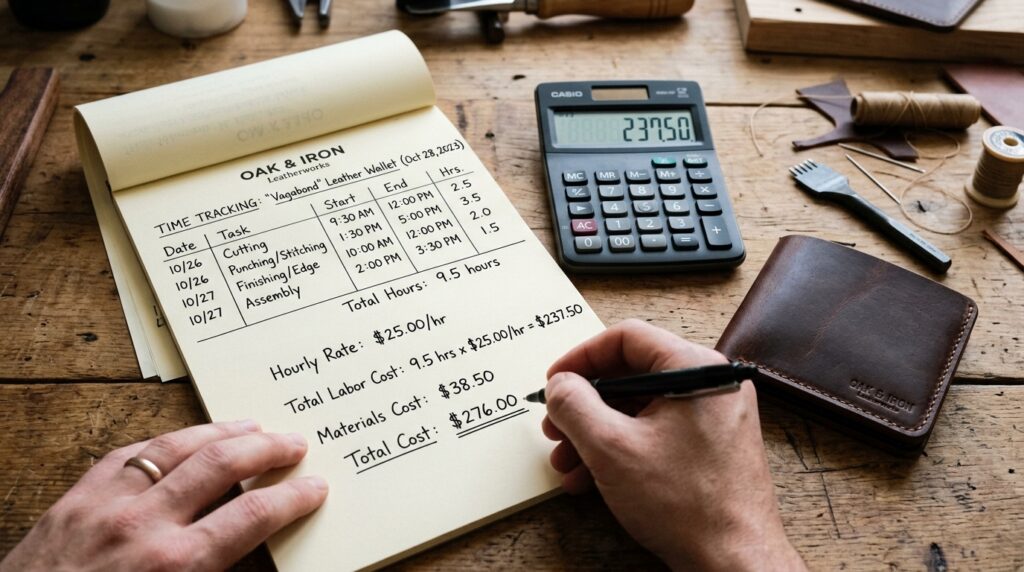
Your time has value. Every hour you spend making a product, photographing it, writing listings, packing orders, and communicating with buyers is an hour you are not doing something else. That time needs to be compensated in your price.
The minimum hourly rate you should pay yourself is at least local minimum wage — but for skilled handmade work, $15–25 per hour is a more realistic starting point. As your skills grow and your reputation builds, that rate should increase.
Here is the test: would you hire someone else to do what you do for the wage your current pricing implies you are paying yourself? If your pricing works out to $3 per hour for your production time, the answer is obviously no — which means your pricing is wrong.
For digital product sellers, value your design time at your market rate for design work. If a freelance graphic designer charges $50 per hour and you spend 3 hours creating a template, your design cost is $150. Spread across 100 sales of that template, each sale carries $1.50 of design cost — making digital products extremely profitable at scale.
💡 TIP: Track your time for one week on every shop-related task. Most sellers are shocked to discover how many hours they are actually working per order. The real hourly rate this implies is usually the wake-up call that makes them finally raise their prices.
Free Shipping: Should You Offer It or Not?
Free shipping is one of the most debated topics on Reddit’s r/Etsy community — and the confusion is understandable because the answer is nuanced.
The argument for free shipping: Etsy’s algorithm gives a ranking boost to listings with free domestic shipping under $6. Listings with free shipping also tend to have higher conversion rates because buyers do not experience sticker shock at checkout when a $15 item suddenly has $6 shipping added.
The argument against free shipping: You are not actually offering free shipping — you are building the shipping cost into your item price. Buyers see a higher item price, which can hurt your perceived competitiveness against sellers who show the shipping cost separately. For heavy or bulky items where shipping costs are significant, building shipping in can make your item price look uncompetitively high.
The practical answer for 2026: For lightweight products where shipping costs $4–6, build it into your price and offer free shipping. The algorithm boost and conversion rate improvement are worth it. For heavier products where shipping costs $10–15 or more, charge shipping separately and keep your item price visually competitive.

Remember — Etsy’s transaction fee applies to the total order value regardless. Free shipping does not reduce your fees. It just moves where the cost shows up.
💡 TIP: If you switch to free shipping, raise your item price by the average shipping cost for your most common order type — not the maximum shipping cost. Overbuilding shipping into your price hurts conversion on local or nearby orders where actual shipping would have been cheaper.
How to Price Digital Products on Etsy
Digital products have a different pricing psychology than physical products. Because there is no obvious material cost, many sellers dramatically underprice them — believing that a $3 price point will drive volume. This is almost always the wrong approach.
Here is how to think about digital product pricing in 2026:
Price based on the value to the buyer, not your production cost. A resume template that helps someone land a $60,000 job is worth far more than the 2 hours it took you to design it. A business budget spreadsheet that saves a business owner 10 hours of work per month is worth more than $5. Price at the value the buyer receives.
Middle-tier pricing converts better than rock-bottom pricing. On Etsy, a $12–18 price point for digital templates and planners consistently outperforms the $3–5 range in revenue because buyers associate higher prices with higher quality — and they are right to do so. The $3 template market is a race to the bottom. The $15 template market is where quality wins.
Top-performing digital product price ranges in 2026:
Printable planners and trackers: $5–15
Editable Canva templates: $8–25
Business and finance spreadsheets: $12–35
Branding kits and logo packages: $25–75
Crochet and sewing patterns: $5–12
SVG cut files: $3–8 per design, $15–30 for bundles

💡 TIP: Test a price increase on your digital products. If you are currently selling a planner for $5, try $9. If your conversion rate holds within a reasonable range, you have just nearly doubled your revenue per sale with zero extra work. Many digital sellers find that moderate price increases have minimal impact on conversion while massively improving profitability.
When and How to Raise Your Prices
Most Etsy sellers are scared to raise their prices. They fear losing sales. But here is what the data consistently shows across the Etsy seller community — a 10–20% price increase typically results in a 0–5% reduction in sales volume, meaning total revenue almost always goes up.
You should raise your prices when:
Your materials or shipping costs increase — which they have in 2026, with carrier rate increases of 5.9–7.8% across all major carriers
You have collected 20+ positive reviews and have demonstrated quality to the market
Your conversion rate is above 3% — high conversion with low price is a signal your product is underpriced
Your processing time is maxed out — if you cannot keep up with demand, raising prices reduces volume while increasing per-order profit
You have not raised prices in 12+ months — inflation is real and your costs have risen even if you have not noticed

How to raise prices without losing momentum: raise in small increments of 10–15% at a time rather than making one large jump. Update your 5–10 best-selling listings first and monitor conversion rate for 2–3 weeks before updating the rest of your shop.
💡 TIP: Never announce a price increase to your customers. Simply update the listing. Most buyers do not track your prices and will not notice a $2–3 increase. The ones who do notice are unlikely to leave over a small change if your product quality and reviews speak for themselves.
Answering the Most Common Etsy Pricing Questions From Reddit
“My competitor is selling the same thing for half my price — what do I do?”
Do not match their price. Either they are losing money and will eventually stop selling, or they have costs you do not understand. Differentiate your listing with better photos, better SEO, and more reviews. A buyer who chooses your $20 listing over a $10 competitor’s is buying quality and trust — not just a product.
“Should I offer a discount for my first few sales to get reviews?”
No — and Etsy’s policies prohibit offering incentives for reviews. Build reviews through follow-up messages and great customer experience. Discounting cheapens your brand before it has even been established.
“How do I handle buyers who ask for a lower price?”
Politely decline and explain the value in your product. You do not need to justify your pricing or apologize for it. “Thank you for your interest — my pricing reflects the materials and time that go into each piece” is a complete and professional response.
“Is it worth selling on Etsy if the fees are so high?”
Yes — but only if your pricing accounts for the fees. Etsy’s traffic and built-in buyer trust are worth the fees for most sellers. The mistake is treating Etsy fees as something to absorb rather than something to build into your price from day one.

Etsy Pricing Checklist for 2026
☐ All material and packaging costs calculated accurately per unit
☐ Your time valued at a fair hourly rate and included in cost calculation
☐ Etsy listing fee ($0.20) included in cost per unit
☐ Transaction fee (6.5%) built into price using gross-up formula
☐ Payment processing fee (3% + $0.25) accounted for
☐ Offsite Ads fee (12–15%) considered — especially if shop earns over $10,000
☐ Profit margin of at least 30–40% added on top of all costs
☐ Shipping cost decision made — free shipping built in, or charged separately
☐ Digital product prices reflect buyer value, not just production cost
☐ Competitor prices researched — but not blindly copied
☐ Price increase schedule reviewed — last increase noted and next one planned
☐ Underperforming listings audited for underpricing
☐ High-conversion listings flagged as potential price increase candidates
Optimize Your Listings for Free to Support Your Pricing → Sellbee
Conclusion
Pricing is not guesswork and it is not a competition to see who can charge the least. It is math — and once you do the math correctly, everything else about running a profitable Etsy shop becomes clearer.
Know your costs. Include every Etsy fee. Pay yourself fairly for your time. Add a real profit margin. Then test, monitor, and adjust as your shop grows.
The sellers making consistent income on Etsy are not the ones with the lowest prices. They are the ones who priced correctly from the start, built their value through great products and reviews, and were not afraid to charge what their work is actually worth.
Do the math. Set the right price. Build the shop you actually want to run.